
GET TO KNOW OUR BLOG
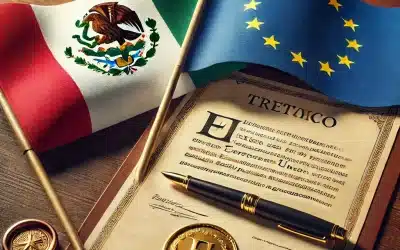
The Free Trade Agreement between Mexico and the European Union (TLCUEM)
In force since the year 2000, the Free Trade Agreement between Mexico and the European Union (TLCUEM) has transformed the commercial relationship between these two regions. This agreement has significantly fostered economic exchange, positioning the European Union...
The Free Trade Agreement between Mexico and the European Union: Impact and Benefits
The Free Trade Agreement between Mexico and the European Union (TLCUEM), in force since 2000, has transformed the trade relationship between both regions. This agreement has fostered significant economic exchange, placing the European Union (EU) as the leading country in the world...

Comparison of the Mexican and Spanish tax systems
One of the main concerns of Spanish investors in Mexico is to understand the Mexican tax system. This is imperative in order to estimate the tax burden of their operations in Mexico, as well as to be able to carry out tax planning within the...

Benefits of Investing in Mexico for Spanish Companies
Mexico is an attractive destination for Spanish investment due to a combination of economic, geographic and regulatory factors: 1.- Trade Agreements: Mexico has 13 free trade agreements with 50 countries, including the Treaty between Mexico, the United States...

The Christmas Bonus in Mexico: Rights, Obligations and Key Aspects
The Christmas bonus is a labor benefit in Mexico established by the Federal Labor Law (LFT), which guarantees workers additional financial compensation at the end of each year. This right aims to provide financial support to face the challenges of the current economic crisis.

Calculation of provisional payments of ISR, VAT and withholdings in the RESICO regime for legal entities
The Simplified Trust Regime (RESICO) for legal entities is a tax option created to facilitate tax compliance for companies with annual revenues of less than $35 million pesos. Through this regime, companies can carry out...

The Purchase Method in the Acquisition of Businesses according to NIF B-7
The purchase method is a fundamental pillar in the process of recognizing business acquisitions according to Financial Reporting Standard (NIF) B-7. This approach seeks to ensure that acquisitions are accounted for in a transparent, consistent and fair manner.

What is a business acquisition according to NIF B-7?
This NIF applies to all entities that issue financial statements in accordance with the terms established in Series A of the NIF, and is applicable to entities that make a business acquisition. According to NIF B-7, a business acquisition occurs when a business is acquired by a company.

NIF B-5 Financial Information by Segments
Financial Reporting Standard B-5 (NIF B-5), entitled "Financial Information by Segments", establishes the guidelines for economic entities to disclose detailed information about their different operating segments. This standard aims to...
NIF B-6 Statement of Financial Position
Financial Reporting Standard B-6 (NIF B-6), entitled "Statement of financial position", establishes the guidelines for the presentation and structure of the balance sheet in economic entities. Its main objective is to ensure that the financial statements are accurate and complete.

NIF B-4 Statement of Changes in Shareholders' Equity
Financial Reporting Standard B-4 (NIF B-4) is key to the presentation and understanding of the statement of changes in shareholders' equity, providing relevant information for all those interested in the financial analysis of an entity. This NIF details the...
Strategies to reduce tax risks: practical tips to minimize common mistakes and avoid penalties
Tax compliance is a key aspect for the success and stability of any company. However, many business owners and accountants make common mistakes that can lead to penalties, fines or even audits by the SAT. Fortunately, these mistakes are...
